Book Review: Cord Swell by Brittny Ray Crowell
Cord Swell (W. W. Norton & Company, 2025)
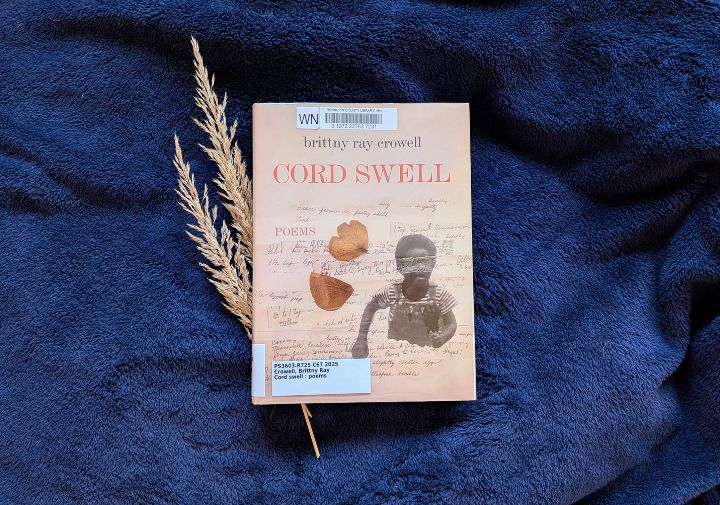
Brittny Ray Crowell’s Cord Swell is an ancestral altar of poetry created by patching together memory, dialogue, and experience with tangible family ephemera, from journals and obituaries to home videos. In “Down 59,” Crowell writes:
“speak home, and watch memory splinter into clover
watch as your hands spin shadows into silk webs
translucent and thin
but broad enough to cross over”
And every poem feels like another thread in that web bridge Crowell builds to gap the space between past and present, living and dead:
“if there’s any such thing
as paradise        some aftervoid
better than the warmth
of your neck, the sun swept
slab of your porch,

with you there, the map
of your palm waving—
how close am i
to that context of space?”

– from “Your Navel Cord’s Well”
But Cord Swell is not just mere nostalgia or a wish for the living to return. Crowell goes beyond memory by excavating her roots to learn from and understand her ancestral past, memorialize her ancestors, and keep herself alive (both figuratively and literally, which I’ll get to later) for the generations to come:
“i can’t explain the cardinals i’ve seen of late
they kindle the trees like small glints of fire
spreading embers amidst the leaves from limb
to limb—but I know the space between us
is as thin as an eyelid and you said that red
birds were a loved one’s rapture—a sign
that we all can somehow seep back beneath
the palimpsest and return.”

– from “Donna’s House on Waterman: Texarkana, TX”
One way Crowell does this is through her “Interview with an Ancestor” series. The interview poems read like a summoning, a way to give her ancestors and still living relatives a voice to outlive their graves—quite literally, as Crowell notes that many lines within these poems were taken from a found document of her deceased grandmother’s as well as her living mother’s and sisters’ responses on their memories of home.
As much as Cord Swell is an altar to ancestral history, it’s also a confrontation of the violence in that history and a vow to end the cycle:
“now that the earth is over you        (a safety)
I take the long way home across your face
map the architecture of your blood
and pray against dying early

by the hands of a man who makes a craft of loving
women like dogs        a man who tames
with heavy petting and violence
who mistakes sweetness for something soft carve”

– from “Scar Elegy”
Crowell also meets this confrontation through persona poems that acknowledge the violence kept buried, as the cycle must be acknowledged in order to be broken. Perhaps this is a stretch, but they may also offer an indirect, post-mortem apology of sorts from the men who did the hurting—the amends deserved but never received:
“I had plenty of time to breathe
against the powder settling in your twilight

scent and didn’t        baby        I’m trying
to save you from the memory”

– from “To the Tune of Why Have I Lost You by Cameo”
I can’t end this review without noting the craft of Crowell’s writing, and I think the excerpts I’ve shared here speak a lot to her ability to turn a line (“baby I’m trying / to save you from the memory”) and create an immersive experience (“some aftervoid / better than the warmth / of your neck, the sun swept / slab of your porch, [. . .] // the map / of your palm waving”). And the way she writes the body is a lesson in crafting evocative imagery that surprises and lingers:
“they sealed your wound with butterfly closures
a kaleidoscope flew up your face for weeks”

– from “Scar Elegy”

“smile wide—prove you are not dangerous
—bring the corners of your broad mouth in tight
display a great lunette of moon-varnished teeth”

– from “How to Play Dead (Again)”

“you are the word caught sideways
in the tender pink of my throat”

– from “A Cleaving”
Cord Swell will make you want to call upon the spirits of your own ancestors, find the truth in familial myth, and create myth from familial truths to pass on to those who come after you.
Learn more about Brittny Ray Crowell at brittnyraycrowell.com .