Book Review: Little Beast by Sara Quinn Rivara
Little Beast (Riot in Your Throat, 2023)
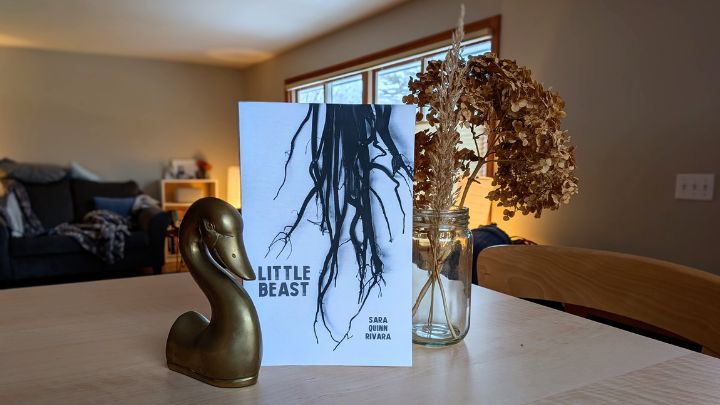
From the opening poem “Wolf,” Sara Quinn Rivara’s Little Beast reads like the fairy tales we know flipped on their heads. And I don’t mean the watered-down versions. I mean the Brothers Grimm versions. The fairy tales elders once told children to scare them into behaving. Only Rivara is a witch burned at the stake returning to teach women how to misbehave, thus coming home to themselves.
Little Beast is Rivara’s journey from domestication to rewilding. In “Witch-Wife,” she “unzips her woman’s skin” to reveal her “damp animal,” “slip(s) into something more comfortable. A deer carcass split down the middle.” Each poem is an undomestication into something feral, the simmer before the boil: “The boy cried. The dog stood still. I gathered them in my arms and began to sing, low and wild.” Something tougher and obscene but also softer—toward herself, for her son—“a strong little mama,” as her son calls her.
I love Rivara’s approach to the impact of the patriarchy on women and womanhood and the ways she fights back. How she knocks God off his pedestal in “Cloud/Breath,” where “God tromps around in his boxers with a warm beer” in “paradise,” while she is the moon, “shimmies onto the field in my sexy deer costume.”
How she masters the mundane, literally in life and figuratively as a poem, in “Dear X—”:
. . . after long enough all stories with women are the same. Pink mold in the shower. Everyone wants something different for dinner and no one // thinks you’re fuckable anymore.
and
Now, every poem // is an attempt to keep the woman I am from becoming a turnip, a radish, a day-old ham.
How, in “Husk,” a man rolls his eyes at “more menopause poems,” reminding the speaker how women are like stars:
At some point, a woman must forget blooming, how bright the body how violent.
[. . .]
O, what was it I taught my son about the stars? Once we can see their fires, they are already gone.
How after a certain amount of hurt, a woman becomes “a wild thing, a lake squall, wood rot,” bares her teeth expecting the worse (“Love Poem, SE Portland”). How, in “Talisman,” “it is easier to imagine what can go wrong than what can bloom”:
I understand only how to practice for catastrophe.
Little Beast is like an apocalypse in reverse. Or how a woman rebuilds herself after surviving it.
And I can’t finish this review without pointing out how strong Rivara’s language is throughout the collection. Her images are so fresh, her language so bold and unique, there isn’t a single poem that doesn’t elicit a visceral reaction. I could write a whole review of just favorite lines and moments that do this, but I’ll share the one that absolutely did me in, that left an ache in my chest that I couldn’t name or pinpoint (an ache she didn’t have to name but did, nailing it to my sternum):
What I was prepared for was my own breakage; a return of cells blooming on my cervix, everything I’d done in twenty years taken away from me. I did not expect you to be on the table. Maybe you should have, my worst mind tells me. You can’t expect joy.
Love burns a small circle between my breasts.
Learn more about Sara Quinn Rivara at saraquinnrivara.com .